
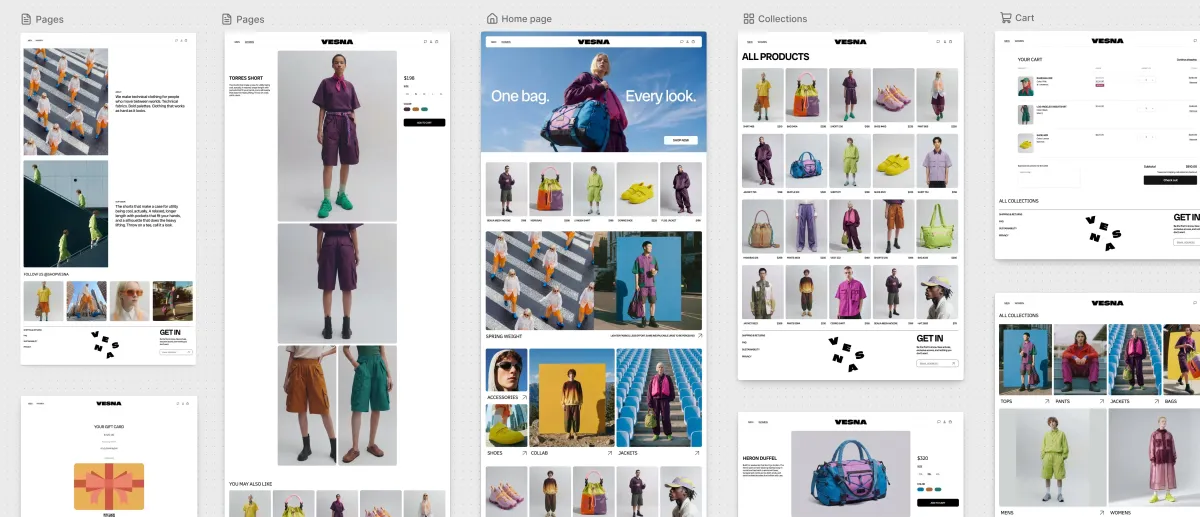
Shopify has introduced Canvas, a new AI-powered website-building experience that allows merchants to create and customize online stores simply by describing what they want in a conversation.
The new tool works alongside Sidekick, Shopify’s AI assistant, and is designed to make store creation faster and more accessible for merchants who may not have coding or web design experience.
Instead of manually navigating through theme settings, rearranging blocks, or editing code, users can ask Sidekick to make changes using natural language while watching the results appear in real time.
Build a Shopify Store by Talking to AI
Canvas gives merchants a visual workspace where they can see multiple pages of their online store at the same time.
Users can move across the entire storefront, zoom into specific pages, and ask Sidekick to make changes through chat.
For example, a merchant could ask the AI to redesign a homepage, adjust a product page, change the visual style of a section, or make the overall design feel more premium.
Sidekick then modifies the store and displays the changes directly inside Canvas.
Merchants can also continue editing elements manually if they prefer, meaning Canvas combines traditional visual editing with conversational AI.
Canvas Works With the Store’s Actual Code
One of the key differences between Canvas and some traditional AI website builders is that Shopify says the workspace is not simply showing a static preview.
Instead, Canvas renders the actual code behind the merchant’s store.
This means users can test animations, interactions, layouts, and other features directly inside the workspace.
Merchants can also preview their pages across different screen sizes and see how designs look with different products or collections.
By working directly with the store’s underlying theme files, Sidekick can make more substantial changes than a traditional drag-and-drop editor.
Sidekick Acts Like an AI Design Partner
Shopify is positioning Sidekick as more than a basic chatbot.
Inside Canvas, the AI assistant can remember previous design decisions and preferences as merchants continue working on their stores.
This allows users to refine a design over multiple conversations without having to repeatedly explain the same visual direction.
Sidekick can also inspect screenshots of its own work and validate the code it generates.
Shopify says this feedback process allows the AI to review how its changes actually appear before presenting the result to the merchant.
The company has also adjusted its theme architecture so Sidekick can better understand and modify a store’s structure, design, and logic.
Shopify Says Custom Stores Can Be Built Much Faster
According to Shopify, Canvas could dramatically reduce the time needed to create a customized online store.
Ben Sehl, Shopify’s Director of Product and co-founder of clothing brand Kotn, said creating a custom store previously required significantly more time and technical expertise.
Shopify now says entrepreneurs can use Canvas and Sidekick to create highly customized storefronts in a fraction of the time traditionally required.
That could be particularly important for small businesses that do not have the budget to hire professional developers or designers.
AI Is Changing How Websites Are Built
Shopify is not alone in integrating generative AI into website design.
Platforms including Wix, Squarespace, Webflow, and Framer have increasingly introduced AI-powered tools that allow users to generate layouts, content, and design elements through conversational interfaces.
Newer AI development platforms have also popularized what is sometimes called “vibe coding,” where users describe an application or website and allow an AI system to generate much of the underlying code.
Canvas brings a similar experience directly into Shopify’s e-commerce ecosystem.
However, Shopify has an advantage in that Canvas is deeply integrated with the platform’s existing commerce infrastructure, including products, collections, themes, and store data.
Canvas Is Still in Its Early Stages
Despite its capabilities, Shopify says Canvas is still an early product.
The company is not replacing its existing theme editor with Canvas at this stage.
Several features are also missing from the initial release.
According to Shopify, initial limitations include support for certain third-party themes, app blocks and extensions, markets, translations, theme updates, and some deployment workflows.
Canvas is also currently designed primarily for desktop use.
Shopify says it plans to expand support and improve the product over time.
Shopify Continues Its Push Into AI Commerce
The launch of Canvas is part of Shopify’s broader investment in artificial intelligence.
The company has increasingly integrated Sidekick throughout its platform, allowing merchants to use AI for tasks such as generating content, modifying themes, analyzing business information, creating apps, and assisting with store management.
Shopify has also been investing heavily in AI-powered shopping and agentic commerce.
Its systems are increasingly designed to allow merchants to sell products through AI assistants and conversational platforms while managing products and orders through Shopify.
Canvas expands that strategy from how consumers shop to how merchants actually build the stores customers visit.
Building an Online Store Could Become More Conversational
Traditional e-commerce website development often requires merchants to choose a theme, customize individual sections, configure settings, and sometimes modify code.
Canvas attempts to simplify that process by turning design decisions into conversations.
Instead of searching through settings to figure out how to make a change, a merchant could simply describe the desired result.
If Shopify can make this approach reliable enough for complex stores, it could lower one of the biggest barriers facing new online sellers: creating a professional-looking storefront without significant technical expertise.
Canvas is rolling out to Shopify merchants over the coming days, and Shopify says the platform will continue evolving as the company receives feedback from users.
For Shopify, the launch represents another step toward a future where building and managing an online business increasingly happens through conversations with AI rather than traditional software interfaces.